Introduction: More Than Just a Cheese
Everything you need to know about Italy's "King of Cheeses," from someone who grew up eating it.
When people think of Parmigiano Reggiano, they usually picture a generous shower of cheese over a bowl of pasta. But in Italy, our relationship with Parmigiano starts much earlier.
Growing up in Naples, Parmigiano Reggiano wasn’t just an ingredient—it was a staple in our kitchen. In fact, many Italian babies are introduced to its flavor as soon as they begin eating solid foods. A simple vegetable purée or broth often gets finished with a spoonful of freshly grated Parmigiano Reggiano and a drizzle of extra virgin olive oil.
Now, before any pediatricians come after me, I know nutrition recommendations evolve, and today’s advice may differ from what our grandparents did. But try explaining that to an Italian nonna! She’ll still tell you that Parmigiano Reggiano can make just about anything taste better.
Like many Italian families, we used Parmigiano on almost everything. Pasta, risotto, soups, vegetables—there was always a wedge in the refrigerator ready to be grated. Sometimes, though, there really can be too much of a good thing.
My uncle is living proof. My grandmother loved Parmigiano so much that she added it to nearly every meal he ate as a child. To this day, he can’t stand the smell of cheese because it reminds him of having Parmigiano on everything growing up. It’s one of those funny family stories that always makes us laugh—although I don’t think he finds it quite as amusing!
For me, however, Parmigiano Reggiano is one of the flavors that instantly brings me back home. After moving from Naples to Chicago, one of the first things I looked for at the grocery store was a real piece of Parmigiano Reggiano. It wasn’t until I started shopping in the U.S. that I realized how confusing buying “Parmesan” can be. Shelves are filled with products labeled “Parmesan,” “Italian Parmesan,” or “Parmesan-style,” but many have very little in common with the authentic cheese I grew up eating.
In this guide, I’ll show you how to recognize authentic Parmigiano Reggiano, explain what makes it so special, share how Italians actually use it in everyday cooking, and, of course, introduce you to some of my favorite recipes that let this incredible cheese shine.
What Is Parmigiano Reggiano?
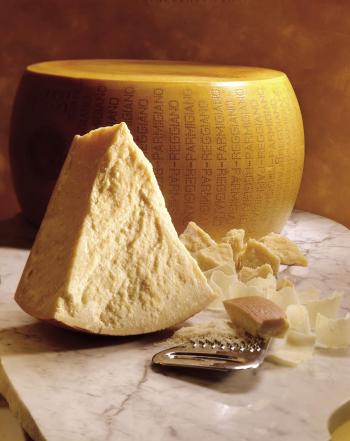
Parmigiano Reggiano is a traditional Italian hard cheese made from cow’s milk and produced according to strict rules that have remained largely unchanged for centuries. Often called the “King of Cheeses,” Parmigiano Reggiano is one of Italy’s most iconic foods and is recognized around the world for its complex flavor, crumbly texture, and incredible versatility.
Authentic Parmigiano Reggiano can only be produced in a specific area of Italy, including:
- Parma
- Reggio Emilia
- Modena
- Bologna (on the left side of the Reno River)
- Mantua (on the right side of the Po River)
Every wheel must follow the production rules established by the Consorzio del Formaggio Parmigiano Reggiano and pass strict quality inspections before it can receive the official name.
A true wheel of Parmigiano Reggiano contains only:
- Milk
- Salt
- Natural rennet
No preservatives.
No additives.
No artificial ingredients. Its incredible flavor comes from the milk’s quality, the cheesemakers’ craftsmanship, and the time it spends aging.
How to Read a Parmigiano Reggiano Rind: The Cheese's Passport
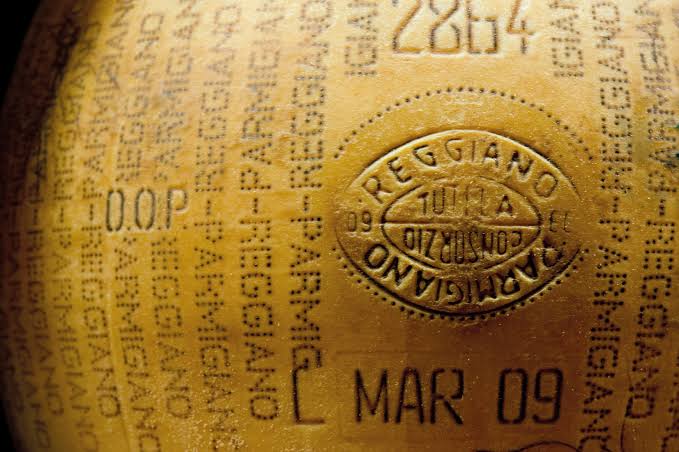
One of the easiest ways to recognize authentic Parmigiano Reggiano is by looking at the rind. Every wheel of Parmigiano Reggiano is marked with a unique series of identifiers that make it completely traceable. from the dairy where it was produced to the day it was made. If you buy a wedge with part of the rind attached, take a moment to look closely. The rind tells the cheese’s story.
Here are the markings to look for:
The words “Parmigiano Reggiano” are pressed into the rind using a dotted pattern that runs around the entire wheel. This is the first and easiest sign that you are looking at authentic Parmigiano Reggiano.
The DOP and Consorzio di Tutela markings
You will also find:
- DOP (Denominazione di Origine Protetta) — the Italian designation that protects foods produced in a specific geographic area following traditional methods.
- Consorzio di Tutela — the organization responsible for protecting and promoting authentic Parmigiano Reggiano.
Dairy identification number
Each cheese factory has its own identification number, which is printed on the rind. This lets you trace the cheese back to the dairy where it was produced.
Parmigiano Reggiano vs. Parmesan: What's the Difference?
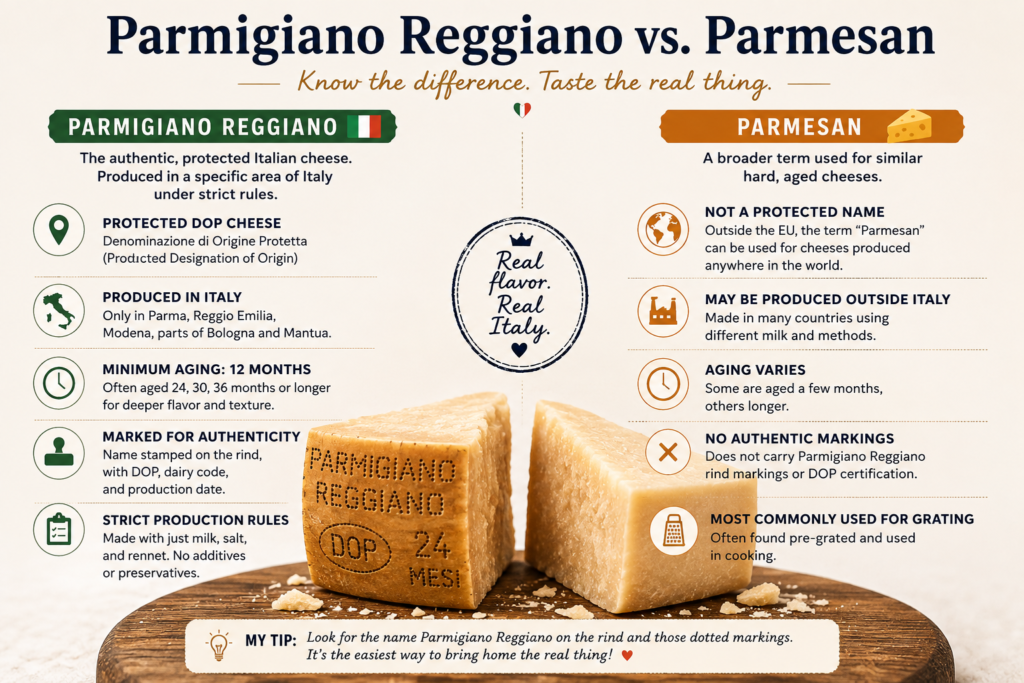
If you have ever stood in the cheese aisle wondering whether Parmesan and Parmigiano Reggiano are the same thing, you are not alone.
The short answer is:
Parmigiano Reggiano is Parmesan, but not all Parmesan is Parmigiano Reggiano.
The two names are often used interchangeably, especially in the United States, but there is an important difference.
So, What Is Parmesan?
“Parmesan” is the English name commonly used for Parmigiano Reggiano, but outside of Europe, the word Parmesan can also be used more broadly to describe similar hard, aged cheeses.
This means that a package labeled simply “Parmesan” is not necessarily authentic Parmigiano Reggiano.
It may have been produced outside Italy, aged differently, or made using a different production process.
That doesn’t necessarily mean it is bad cheese. There are many delicious Parmesan-style cheeses produced around the world.
But if you are looking for the specific cheese known as Parmigiano Reggiano, you should look for its name and markings—not just the word Parmesan.
A Simple Way to Think About It
I like to explain it this way:
Parmigiano Reggiano is a specific cheese. Parmesan is a broader category or name that can be used for similar cheeses.
It is similar to ordering sparkling wine versus Champagne. All Champagne is sparkling wine, but only sparkling wine produced in the Champagne region of France following specific rules can be called Champagne.
The same idea applies here.
How Does Parmigiano Reggiano Taste Different?
The difference becomes especially noticeable when you taste Parmigiano Reggiano on its own.
Authentic Parmigiano Reggiano has a complex flavor that can range from:
- Buttery
- Nutty
- Fruity
- Savory
- Slightly sweet
As it ages, the flavor becomes deeper and more intense.
It also develops its characteristic grainy, crumbly texture and those tiny crunchy crystals that I personally love finding in a good piece of Parmigiano.
Many generic Parmesan cheeses are saltier and have a more uniform texture. They can work well in cooking, but they do not always offer the same complexity as Parmigiano Reggiano.
And this is where I think the difference really matters: if Parmigiano is one of the main ingredients in your dish, it is worth using the real thing.
For a recipe where you are simply adding a small amount of cheese to a sauce with many other strong flavors, you may not notice a dramatic difference. But in a simple dish like Pasta al Burro, Risotto alla Parmigiana, or even a piece of warm bread with olive oil and Parmigiano, the cheese is the star.
That’s when I would choose Parmigiano Reggiano.
My Tip When Shopping
If you want authentic Parmigiano Reggiano, don’t rely only on the front of the package.
Look for:
- The name Parmigiano Reggiano
- The distinctive dotted inscription on the rind
- DOP identification
- Information about the cheese’s aging
And whenever possible, buy a wedge with the rind still attached.
Not only is it one of the easiest ways to recognize the real thing, but in my opinion, buying a wedge and grating it yourself also gives you a much better flavor than buying a container of pre-grated cheese.
Because once you have tasted freshly grated Parmigiano Reggiano, it’s hard to go back to anything else.